1. Introduction
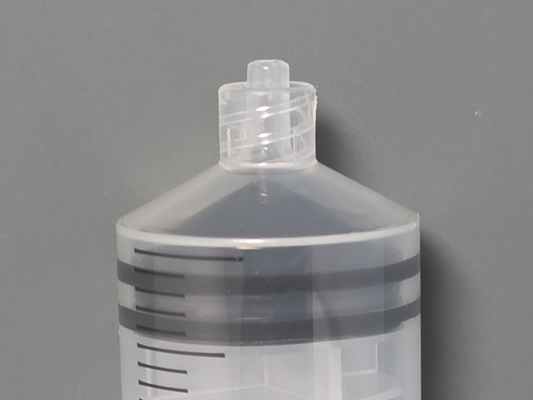
Hospital pharmacies demand high levels of precision and reproducibility in compounding. At The Compounding Company, we aim to provide users — particularly pharmacists — with insight into the technical reality behind the seemingly simple process of drawing and dosing liquids. In this whitepaper, we focus on the mechanical loads involved in using a 50 ml polypropylene (PP) syringe, including associated tolerances and the impact on accuracy.
This paper is part of a series, following earlier discussions on measurement accuracy and gravimetric accuracy. Here, we concentrate on the mechanical behaviour of syringe motion and the resulting deviations.
2. Mechanical Forces During Drawing
When a liquid is drawn into a syringe, multiple forces and mechanisms act on both the plastic (the barrel) and the rubber (the stopper), with the stopper being moved by the plunger.
2.1 Pressure differential (ΔP)
- The force drawing the liquid is generated by negative pressure (vacuum) in the syringe barrel.
- This pressure is created by pulling back the plunger.
- Resistance (e.g., from a narrow needle or connector, such as a SmartSite) creates a pressure drop that limits the drawn volume.
2.2 Effect on plastic (PP)
- Radial contraction: the barrel wall slightly contracts inward due to underpressure.
- Axial stretch: the barrel elongates slightly due to elastic deformation.
- Impact: the calculated height overestimates the volume because the actual diameter is smaller than assumed.
2.3 Effect on rubber (stopper)
- Decompression: the rubber tip relaxes under lower pressure.
- Friction/slip: slip may occur under low resistance, especially if lubrication is insufficient or friction is uneven.
2.4 Cavitation and bubble formation
- At high draw speeds and low pressure (e.g., through a narrow needle), cavitation can occur.
- This results in microbubbles entering or forming in the fluid, optically occupying volume without contributing to actual mass.
3. Mechanical Forces During Dosing
When dosing liquid from a syringe, overpressure develops, affecting both the plastic of the barrel and the rubber of the stopper. These effects influence dosing accuracy, particularly at higher speeds or with resistance in the system.
3.1 Effect on plastic (PP)
- Radial expansion: the barrel wall expands slightly under pressure, creating extra internal volume.
- Axial compression: the syringe shortens slightly.
- Impact: this deformation leads to temporary loss of delivered volume.
3.2 Effect on rubber (stopper)
- Compression against barrel wall: increasing pressure pushes the rubber tighter against the wall.
- Friction increases: especially during fast dosing, this may lead to pressure loss or delayed start.
4. Effects by Material
4.1 Polypropylene (PP) – the syringe barrel
During drawing (underpressure): – Radial contraction: the wall contracts slightly inward, reducing effective diameter. – Axial elongation: slight increase in barrel height. – Effect: can result in underestimation of drawn volume when height is used as proxy.
During dosing (overpressure): – Radial expansion: the barrel expands slightly. – Axial shortening: barrel compresses minutely. – Effect: can lead to small volume losses during dosing.
4.2 Rubber – the stopper
During drawing: – Decompression: rubber relaxes as internal pressure drops. – Slip risk: lower friction may cause jerky movement, especially at low resistance.
During dosing: – Compression: rubber is forced outward, increasing friction. – Delay: pressure buildup may cause delayed or inconsistent dosing.
5. Impact on Accuracy
Based on a realistic simulation model and practical testing, deviations of several millilitres can occur when drawing 50 ml. This effect cannot be attributed to a single factor but arises from a combination of syringe properties (e.g., diameter and wall thickness), connected devices (needles, spikes, connectors), and operational parameters such as speed and pressure. Each setup has its own behaviour, making systematic assessment per configuration essential.
6. Relevance for Pharmacy Practice
It is critical that pharmacists: – Do not rely solely on the set volume of the syringe, – Understand the mechanical limitations and variability of their tools, – Realize that faster dosing typically results in more deviation, – Recognize that despite CE-marking, PP syringes are not high-precision dosing systems.
7. Conclusion
The Compounding Company takes into account the forces and deviations described above when designing its systems. The Compounder uses gravimetric verification to check the mass of each dose. Deviations due to underpressure, overpressure, cavitation, and deformation are managed through a combination of precisely adjustable parameters and process control. This allows a suitable configuration for each syringe/tool combination, contributing to reproducibility and safety in practice. The result is a robust and repeatable process, independent of tolerances in syringes, needles, or spikes.
This raises the question of how the same level of reproducibility can be guaranteed in a manual setting. Without active feedback on mass or compensation for physical effects, manual compounding remains vulnerable to deviations — especially at small volumes, higher speeds, or when using flow-restricting devices.
The forces at play during compounding are real, measurable, and impactful on accuracy. The Compounding Company leverages these insights to develop systems that compensate for or visualize these physical limitations. By making these processes transparent, we help pharmacists form realistic expectations — ultimately improving patient safety.