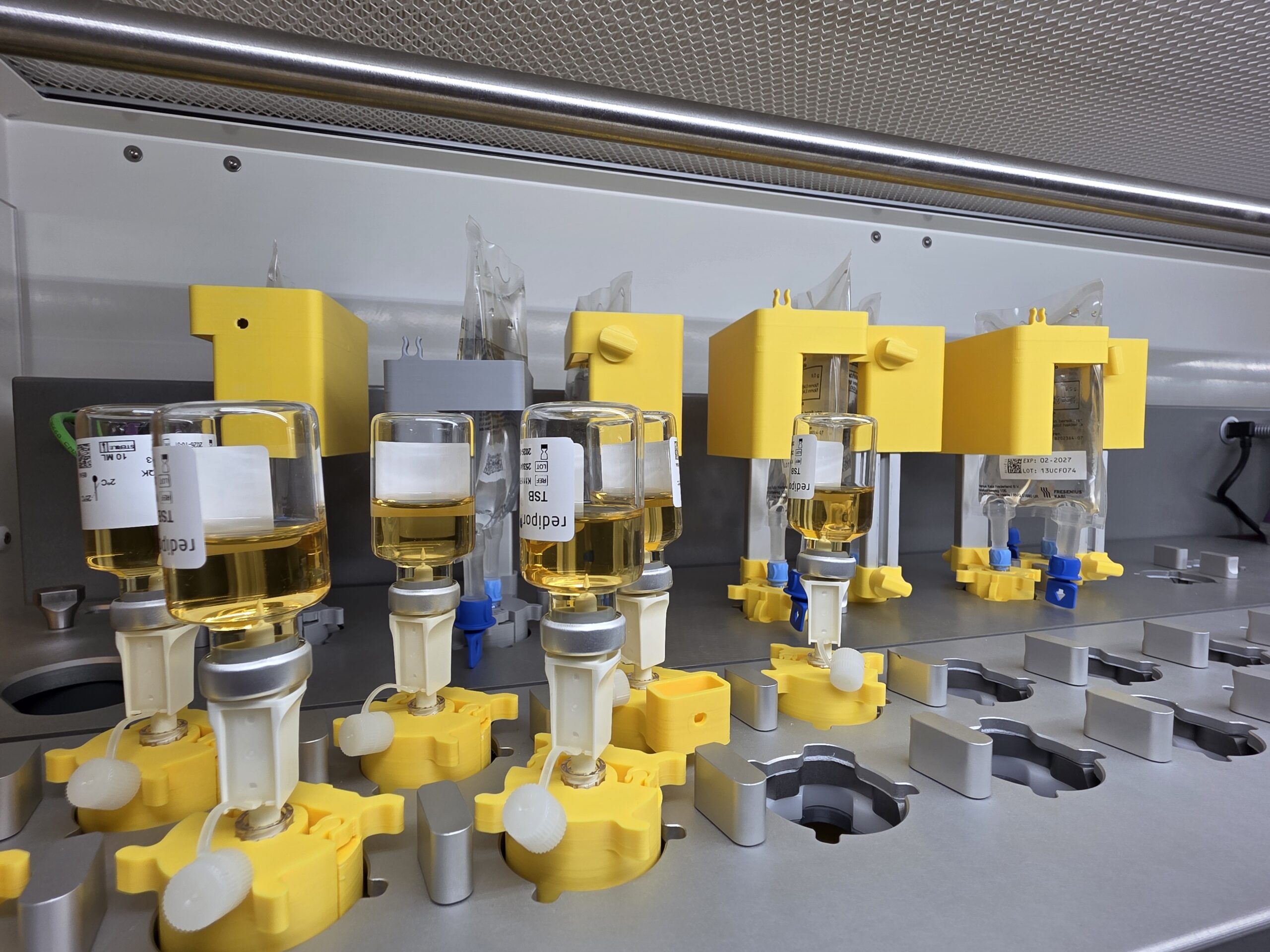
System overview & capacity
What is The Compounder?
The Compounder is an automated compounding system used to prepare sterile parenteral medication such as IV bags, elastomeric pumps, cassettes, and syringes. It increases accuracy, traceability, and efficiency while reducing manual handling. It can be placed inside a downflow cabinet, under a hood or (in case of ward preparations) on a desk.
Who uses The Compounder?
The Compounder is designed for trained pharmacists, pharmacy assistants, and pharmacy technicians working in hospital pharmacy and/or other specialized compounding pharmacy environments.
What types of products can be prepared with The Compounder?
The Compounder supports the preparation of: IV infusion bags, elastomeric pumps, syringes and cassettes.
How many preparations can The Compounder handle in one run?
The Compounder can process up to 10 preparations per batch, depending on the selected products, containers, and configuration. Each output position contains an individual weighing scale.
How many different drugs can be processed simultaneously?
The transport syringe cabinet can hold up to eight transport syringes facilitating the use of maximum eight different APIs in one production batch. Up to 24 vials can be loaded on The Compounder for one run.
Can a syringe be used for multiple medications?
No. Each transport syringe is dedicated to a single medication type (medication with same concentration and ingredient) but may be used for multiple containers of that same medication.
Which transport syringes are supported?
The Compounder supports standard 50 ml transport syringes from major suppliers like Codan, Becton Dickenson and BBraun. For specific CSTD configurations, 30 ml syringes can be used with an alternative dosing head.
Does The Compounder support both Luer-Lock and CSTD?
Yes. The system supports Luer-Lock or CSTD connectors from most major suppliers.
Is The Compounder brand-agnostic for disposables?
Yes. The system is designed to work with a wide range of commonly available vials, bags, syringes, elastomeric pumps, Luer-Lock connectors and CSTDs using dedicated adapters.
Where can I find a list of compatible consumables?
A detailed and continuously updated list of compatible consumables is available upon request from The Compounding Company.
Are needles used during compounding?
No. The Compounder operates needle-free, reducing the risk of needle-stick injuries.
What does a typical workflow look like?
- Orders and batches are prepared in the software
- A picking list is generated
- The machine is loaded following on-screen instructions
- Compounding runs fully automated, the operator can prepare the next run.
- The machine guides unloading, labelling, and cleaning
Does the operator need to stay logged in during production?
No. After starting production, the operator is logged out automatically. Progress can still be monitored on the machine screen.
Safety & CE compliance
Is The Compounder CE and MID compliant?
Yes. The Compounder complies with relevant EU directives, including the Machinery Directive, EMC Directive, RoHS Directive, and EU Measuring Instruments Directive (MID), and carries CE+M marking.
What safety features are built in?
The Compounder includes:
- An emergency stop button on the front panel
- Safety sensors on the flow cabinet window
- Safety sensors on the transport syringe cabinet doors
If a safety condition is not met, the machine will not start or will stop automatically.
Loading The Compounder, accuracy & traceability
How are medication containers identified?
All input and output containers are identified using RFID and photographed by the vision unit, ensuring full traceability throughout the process.
What happens if a container is placed incorrectly?
The system verifies container identity before each extraction and dosing step. If a mismatch is detected, the process stops and the operator is notified.
How are remnants handled?
If enabled, remaining volumes are automatically identified, labelled, and stored with calculated expiration dates.
How accurate is dosing with The Compounder?
Liquid transfer is performed volumetrically with step sizes of approximately 50 microlitres, while verification is done gravimetrically using precision weighing units.
How is traceability ensured during compounding?
All critical steps are logged via software, RFID identification, vision-based image capture, and gravimetric measurements, providing full end-to-end traceability.
Are lot numbers and charge numbers recorded?
Yes. Lot and charge numbers for medications and consumables can be recorded and enforced as mandatory, supporting GMP compliance.
Performance & throughput
What is the typical production speed?
Typical, average hourly output (including loading, unloading, and labelling) is:
- 30–40 IV bags
- 40-80 syringes
- 15-25 elastomeric pumps
Actual throughput depends on volumes, number of vial connections, and local workflow design.
Can operators perform other tasks during production?
Yes. The Compounder operates fully automated, allowing operators to prepare the next batch or perform other pharmacy/cleanroom tasks during production.
Software & approvals
How do users access the software?
The software is accessed via a web browser using a personal user account. Roles determine which functions are available for the user.
Why are approvals required?
Approvals support GMP compliance and quality assurance. Articles, medications, recipes (how to prepare a medication), and medication orders typically require two (preferably independent) approvals before use.
Can The Compounder integrate with hospital information systems or pharmacy information systems?
Yes. The software supports CSV imports and is designed to interface with third-party prescription and pharmacy systems, for example through HL7.
Does The Compounder require an internet connection?
No. The software is deployed on-premises on customer-provided servers and does not require an internet connection for operation.
What IT infrastructure is required?
A dedicated physical or virtual server is required for the software, database, and services. Microsoft SQL is used as the database.
Cleaning & maintenance
When must the machine be cleaned?
Cleaning is required after each batch. The operator can choose routine cleaning or intensive cleaning with partial disassembly.
Which cleaning agents should be used?
Disinfectant wipes or sprays containing isopropyl alcohol are recommended.
How long does cleaning take?
Routine daily cleaning typically takes less than 10 minutes. Full cleaning with disassembly takes approximately 30 minutes.
Who performs maintenance?
Maintenance is carried out in consultation with The Compounding Company by trained staff of The Compounding Company, an authorized distributor or trained staff of the customer.
Physical specifications & installation
What are the dimensions of The Compounder?
The Compounder 10 measures approximately 1200 × 450 × 510 mm (width × depth × height), including the control cabinet. 10 outputs, 24 inputs, 8 transport syringes.
The Compounder 8 measures approximately 1000 × 450 × 580 mm (width × depth × height), including the control cabinet. 8 outputs, 18 inputs, 6 transport syringes.
The Compounder 5 measures approximately 800 × 450 × 580 mm (width × depth × height), including the control cabinet. 5 outputs, 12 inputs, 4 transport syringes.
Preferred work area height >700 mm
What is the weight of The Compounder?
For The Compounder 10: The fully assembled system weighs approximately 60 kg. With modular components removed, the weight is around 40 kg.
Can The Compounder be installed in standard LAF cabinets?
Yes. The system is designed for use in LAF cabinets and downflow hoods. Cabinets wider than 160 cm and with a working area height above 70 cm are recommended.
What environmental conditions are required?
The Compounder is designed for pharmacy and cleanroom environments, operating at temperatures between 15–25 °C and humidity levels of 10–85%.
Does the system generate significant noise or heat?
No. Noise levels remain below 70 dB, and power consumption is under 200 W, so it does not affect cleanroom temperature.
Who installs The Compounder?
Initial installation and first start-up are performed by specialized staff from The Compounding Company or an authorized distributor.
Can the machine be moved after installation?
Yes, but only following the transport instructions in the operator manual. The transport mechanism must be secured, and the machine should be lifted by two people.
Customer support
What should I do if an error occurs?
Follow the on-screen instructions. If the issue cannot be resolved safely, contact technical support at The Compounding Company or an authorized distributor.
Can production continue if an input, output or syringe position is unavailable?
Yes. Individual input, output, or syringe positions can be disabled in the software so production can continue with reduced capacity.
How can I contact technical support at The Compounding Company?
The Compounding Company
Phone: +31 (0)23 201 41 52
Email: service@thecompoundingcompany.com
EU MID compliance
What is the EU Measuring Instruments Directive (MID)?
EU legislation that regulates legally relevant measuring instruments, including automated weighing systems.
When does an automated compounding system fall under the MID?
When it performs automatic weighing without operator intervention as part of a defined process.
Why is MID relevant for pharmacists?
Because gravimetric data may support dose verification and release decisions with legal responsibility.
What does CE + M marking mean?
The system’s weighing function has been independently assessed under EU legal metrology.
Is a standard CE mark sufficient?
No. CE covers safety; CE + M covers metrological accuracy and legal traceability.
Does internal validation (IQ/OQ/PQ) replace MID certification?
No. Validation confirms performance, not legal metrology compliance.
Are certified balances enough to make a system MID-compliant?
No. MID applies to the integrated system, not individual components.
Is using a non-EU-MID system illegal?
Not automatically, but it significantly increases regulatory and evidentiary risk.
Why does MID compliance matter in audits or incidents?
It provides a legally defined, third-party–assessed reference for weighing accuracy.
What is the main risk of non-MID systems?
The full burden of justification rests with the pharmacist or institution.
What does true MID compliance look like?
A system with CE + M marking, Notified Body number, year, and defined metrological parameters.
Who benefits most from MID-compliant systems?
Pharmacists, QA managers, and institutions responsible for patient safety and regulatory defensibility.